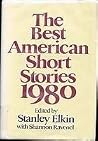
 The Best American Short Stories 1980 by Stanley Elkin
Gratitude
Thank you to Montgomery County Public Library’s ILL and Washington College for allowing me to read Best American Short Stories 1980 edited by Stanley Elkin and Shannon Ravenel.

Personal History

I have been lowkey working my way through The Best American Short Stories series, which began in the early 20th century and continues today. The series has been through many editorships, and starting in 1978, the editor would choose a different author to work with each year. The series editor would read most every short story published in literary journals in US and Canada and then hand the top two hundred or so to the famous author, who would whittle the choices down to around twenty.
Volumes of The Best American Short Stories were used in my college courses, and I, in turn, have used them in my college courses. One of the benefits of reading the series and using it for courses is that it varies from year to year, some offerings better than others. Paired with another anthology, it adds variety and contemporary tastes.

The 1980 edition is a bit different from some of the other volumes I have read. First, several of the stories felt like very long short stories, and not always pleasantly so. Second, I was surprised by the amount of marital dissatisfaction and affairs. I am not astounded that people might be unhappy with their marriages and might cheat, however, I am surprised by the sheer number of stories which focused on this. It seemed like there was an inordinate amount of extra-marital affairs.
Two stand outs are “The Old Forest” by Peter Taylor, which, while it is about a young man who has been caught cheating on his fiancée, also explores the gender politics of the situation; and “At the Anarchists’ Convention” by John Sayles, which while it did not have much weight, was very funny. It is hilariously set, as the story states, at a convention of older anarchists at a yearly convention. The social politics are like that of a family, deep, interconnected, and inherently amusing.
Volumes of The Best American Short Stories were used in my college courses, and I, in turn, have used them in my college courses. One of the benefits of reading the series and using it for courses is that it varies from year to year, some offerings better than others. Paired with another anthology, it adds variety and contemporary tastes.

The 1980 edition is a bit different from some of the other volumes I have read. First, several of the stories felt like very long short stories, and not always pleasantly so. Second, I was surprised by the amount of marital dissatisfaction and affairs. I am not astounded that people might be unhappy with their marriages and might cheat, however, I am surprised by the sheer number of stories which focused on this. It seemed like there was an inordinate amount of extra-marital affairs.
Two stand outs are “The Old Forest” by Peter Taylor, which, while it is about a young man who has been caught cheating on his fiancée, also explores the gender politics of the situation; and “At the Anarchists’ Convention” by John Sayles, which while it did not have much weight, was very funny. It is hilariously set, as the story states, at a convention of older anarchists at a yearly convention. The social politics are like that of a family, deep, interconnected, and inherently amusing.

Would I Teach This Book?

Would I teach The Best American Short Stories 1980? I have taught many volumes of The Best American Short Stories, but have not taught any retro volumes. I would not teach this retro volume. I admit that this was the only time I have ever been bored by Best American Short Stories. There were several times when it felt painful to keep going. My daughter asked me why I felt I had to finish it, and I explained that I never DNF books, and she asked what that was, and I explained. But, it’s true--it might take me years to finish books, as I read other books in between, but I always come back to finish them. In part, because I believe that every book has something to teach me, whether I enjoy it or not.
What was your last DNF? Let me know in the comments!
View all my reviews
What was your last DNF? Let me know in the comments!
View all my reviews


